
Indoor Air Quality Statistics and Data for 2026
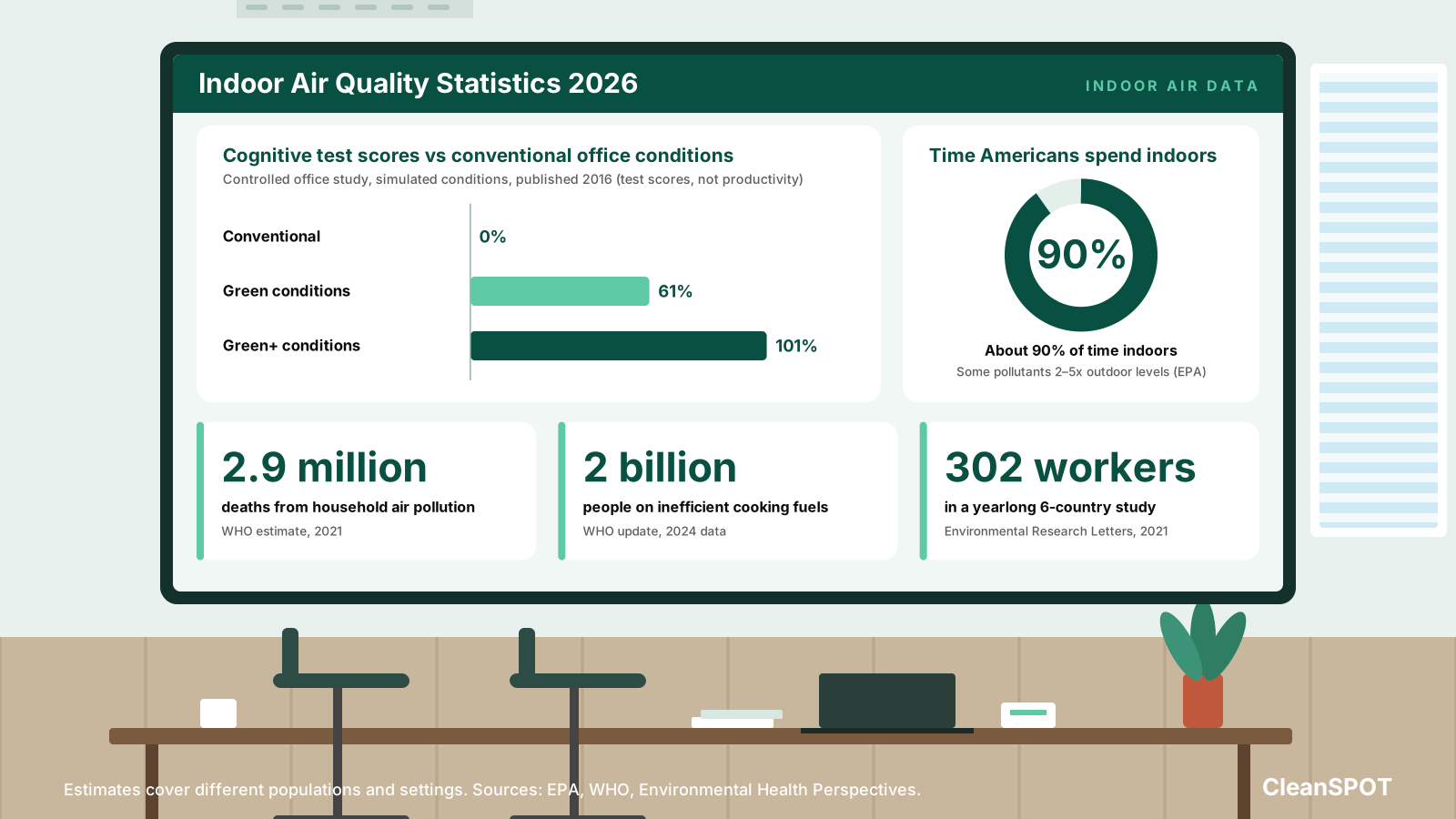
Indoor air quality statistics explain why the air inside buildings deserves attention. Americans spend about 90% of their time indoors, where some pollutant concentrations are often two to five times typical outdoor levels, according to the US Environmental Protection Agency. These are established background estimates, not a new survey of buildings in 2026.
The more useful question for a facility manager is what to measure and control in a particular space. An office, laboratory, and production room do not have identical sources, occupancy patterns, or environmental requirements. This guide separates exposure statistics, workplace research, and moisture-control guidance so the numbers can support a clear building brief without promising results that the evidence cannot establish.
- About 90% of Americans’ time is spent indoors, an established exposure estimate summarized by the EPA’s Report on the Environment.
- Some indoor pollutant concentrations are often two to five times typical outdoor concentrations, according to the EPA. This does not apply to every pollutant or building.
- Approximately two billion people relied on inefficient cooking stoves and fuels in 2024, according to a WHO update published in June 2026.
- An estimated 2.9 million deaths in 2021 were attributable to household air pollution. WHO household air pollution fact sheet.
- More than 309,000 of those deaths affected children younger than five in the same 2021 estimate. WHO household air pollution fact sheet.
- About 95 million disability-adjusted life years were attributed to household air pollution in 2021. WHO household air pollution fact sheet.
- 61% higher cognitive test scores were recorded under simulated Green conditions than Conventional conditions in a controlled office study published in 2016. Original study held by Harvard.
- 101% higher cognitive test scores were recorded under Green+ conditions in that study. These are test results, not measured increases in employee output. Original study held by Harvard.
- 302 office workers across six countries participated in a separate yearlong study published in 2021. Environmental Research Letters study.
- 42 office buildings were included in that study’s analysis of indoor pollution and cognitive performance. Environmental Research Letters study.
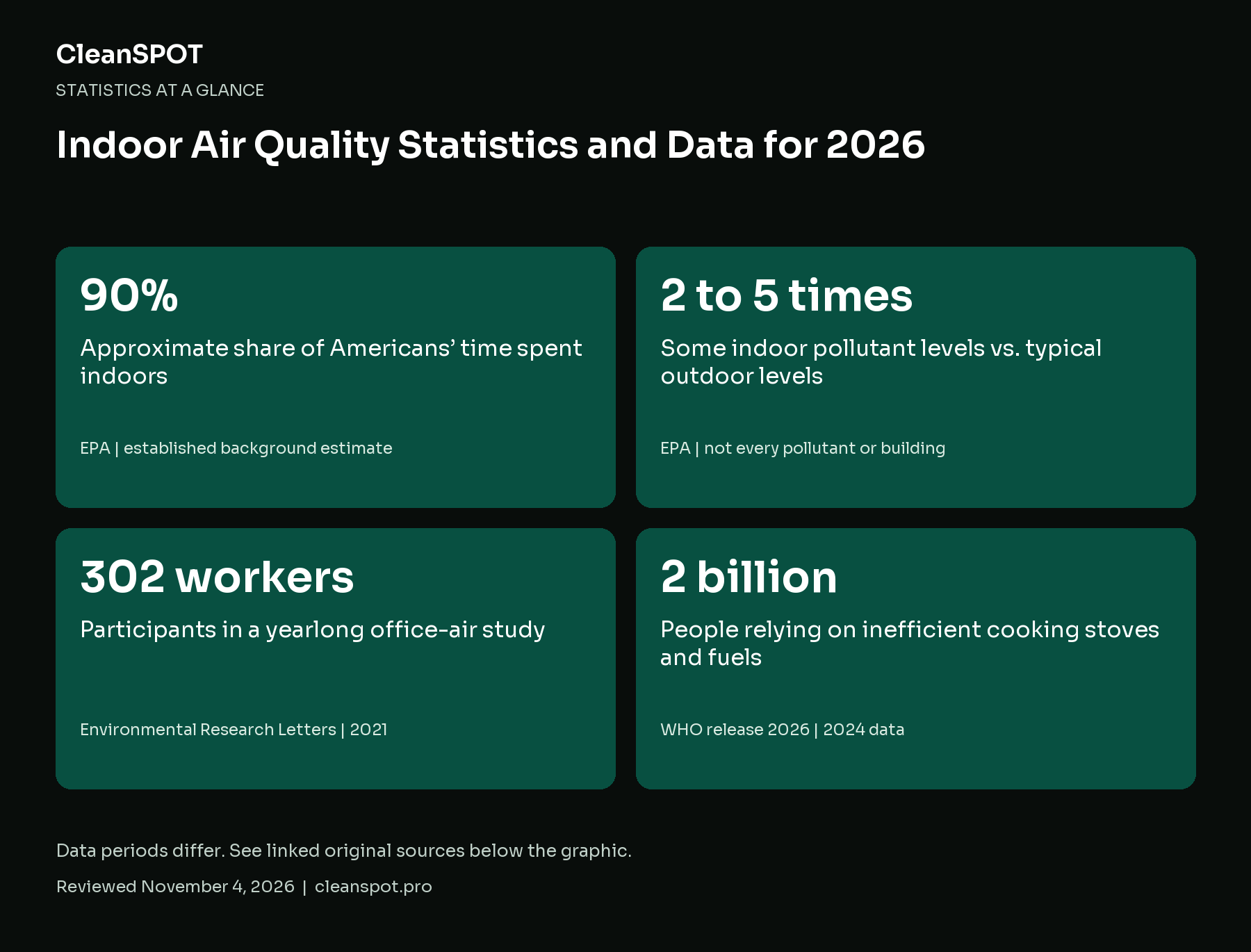
Graphic sources: EPA background estimates · Office-air study · WHO 2026 update
Exposure Statistics Explain the Need for Building-Level Data
The EPA’s July 2025 indoor-air factsheet identifies occupants, materials, outdoor air, moisture, and building systems as factors affecting indoor conditions. It groups the main improvement approaches into source control, ventilation, and filtration or air cleaning.
That is a useful structure for an investigation. Start with what enters the room, what is generated inside it, and how air moves through it. Then decide which measurements will help distinguish those sources instead of purchasing a sensor package with no question attached.
A building-wide average can be a starting point, but it should not be the entire investigation. Consider whether the readings represent occupied workstations, process areas, or a return-air location. Record the measurement position so a later comparison refers to the same conditions.
Do Not Turn an Indoor-to-Outdoor Ratio Into a Building Diagnosis
The two-to-five-times figure applies to some pollutants under the conditions summarized by the EPA. It does not mean that indoor air is always worse than outdoor air, or that multiplying an outdoor reading will estimate a room’s concentration.
For a building assessment, compare like measurements. Keep the pollutant, units, instrument, and sampling period consistent. A short indoor peak and a daily outdoor average cannot establish a reliable ratio between the two environments.
This is where a monitoring brief earns its value. State whether the purpose is to find a source, investigate a complaint, assess a control change, or document an operating condition. Different questions may need different sampling locations and durations.
Workplace Studies Show Associations, Not Guaranteed Returns
In the controlled office study published in Environmental Health Perspectives, researchers compared cognitive performance under simulated building conditions with different ventilation and pollutant characteristics. The higher test scores belong to those experimental conditions.
They should not be converted into a promise that a ventilation change will double a company’s revenue or that a humidifier will produce the same result. The study did not test CleanSPOT equipment, and cognitive test performance is not identical to day-to-day productivity.
The 2021 multicountry office study followed workers over a year and found associations between higher indoor particulate matter or carbon dioxide and poorer performance on several cognitive measures. It was observational, so its findings need to be read within that design.
Turn Research Into a Testable Building Question
A responsible project question might ask whether a planned change alters the measured condition during normal occupancy. It should name the variable and the operating context before work begins.
For example, an engineering team could compare the same monitored locations before and after an agreed system adjustment. The plan should record occupancy, operating schedules, outdoor conditions, and maintenance changes that could complicate interpretation.
Do not choose a percentage improvement from a published paper as the building’s promised result. Set acceptance criteria around the actual engineering specification and the measures the project can substantiate. If health or performance outcomes are being evaluated, involve people qualified to design and interpret that work.
Household Air-Pollution Figures Need a Separate Context
The WHO household air-pollution estimates concern exposure associated with polluting household fuels and technologies. The deaths and disability burden should not be relabeled as outcomes from ordinary office air or industrial humidity problems.
A disability-adjusted life year combines years lost through premature death with years lived with disability. It is not a count of people, so it cannot be added to an illness or death total.
WHO’s June 2026 SDG update provides a newer reference point for cooking access, with about two billion people relying on inefficient stoves and fuels in 2024. Keep this measure separate from the 2021 health-burden estimates.
For a commercial facility, the lesson is to keep the source of exposure attached to the statistic. A large global number can establish public-health importance, but a project brief still needs evidence about the building, its activities, and the people using it.
Match the Control to the Problem
Do not treat “air quality” as a single equipment category. A humidity requirement, particulate concern, combustion source, and chemical exposure question each need their own assessment.
Before requesting a proposal, write down the unwanted condition in plain language. Include when it occurs, where it has been measured, and what action has already been taken. If the problem has not been measured, identify the evidence needed before a performance claim can be made.
This prevents a specification from quietly changing during procurement. A device selected to add moisture should not be evaluated as though it were selected to remove particles. Keep those functions explicit in the project documents.
Humidity Guidance Is Different From Pollution Statistics
The EPA’s mold-prevention guidance recommends prompt removal of unwanted water and drying wet areas within 48 hours. It calls for routine attention to humidifiers, HVAC systems, and condensate pans.
These are prevention and maintenance instructions, not survey findings about how many buildings have mold. They should be labeled as guidance when included beside numerical research findings.
Humidity targets need a clear application too. A laboratory’s validated conditions, a storage requirement, and an office comfort objective should not be merged into one universal setting. The project owner should identify the applicable design requirements before selecting capacity or controls.
Relative Humidity Does Not Describe Every Surface
Our guide to dew point explains the temperature at which air reaches saturation under the stated conditions. It helps connect an air reading with the possibility of condensation on a colder surface.
When investigating moisture, record temperature and relative humidity together rather than retaining only a daily RH average. Include the location and operating state so engineers can interpret what the reading represents.
The CleanSPOT psychrometric calculator can support calculations using those air conditions. Treat a calculation as an engineering input, not proof that every part of a room or duct remains within its required range.
Include Maintenance in the Specification
The EPA mold course warns that poorly maintained humidifiers and HVAC components can become contamination sources. A purchase specification should cover access, cleaning, drainage, inspection, and responsibilities alongside output capacity.
Ask who will inspect the installation, where records will be kept, and how an abnormal reading will be investigated. Confirm that the operating team can reach the components it must maintain without improvising a new procedure each time.
For a central installation, our explanation of air handling units introduces the system context. Understanding where humidification fits makes it easier to discuss controls, airflow, and service access with the project team.
What Has Changed in the 2026 Evidence Picture?
The newer WHO release updates the cooking-access reference year to 2024. EPA’s current indoor-air resources continue to explain source control and building maintenance, while the workplace studies above remain older research with clearly stated publication dates.
There is no single new 2026 statistic that describes the air in every building. Combining the latest release date with older research can be useful, provided the article keeps each dataset’s period and purpose visible.
For your own building, make the next review easier by retaining a consistent record. Include the parameter, units, location, measurement period, instrument, and operating conditions. Add the action taken when a value falls outside the project’s approved limits.
Keep the source file or report link beside any benchmark used in a presentation. That lets a reviewer distinguish a legal requirement, design criterion, guidance value, research result, and public-health estimate before approving expenditure.
Define the Humidity Requirement Before Choosing Equipment
At CleanSPOT, we offer industrial ultrasonic humidifiers in direct-room and duct or AHU configurations. Share the room conditions, target range, airflow, and installation requirements so we can discuss humidity control as one defined part of your facility’s environmental plan.
- US EPA, Report on the Environment: Indoor air quality
- WHO, SDG data update on air pollution and health (June 2026)
- WHO, Household air pollution and health fact sheet
- Allen et al., controlled office study (Environmental Health Perspectives, 2016)
- Environmental Research Letters, multicountry office study (2021)
- US EPA, Indoor air quality factsheet
- US EPA, Mold course chapter 9
Share the room conditions, target range, airflow and installation requirements so we can discuss humidity control as one defined part of your environmental plan.
Request a quote