
Healthcare-Associated Infections Statistics for 2026
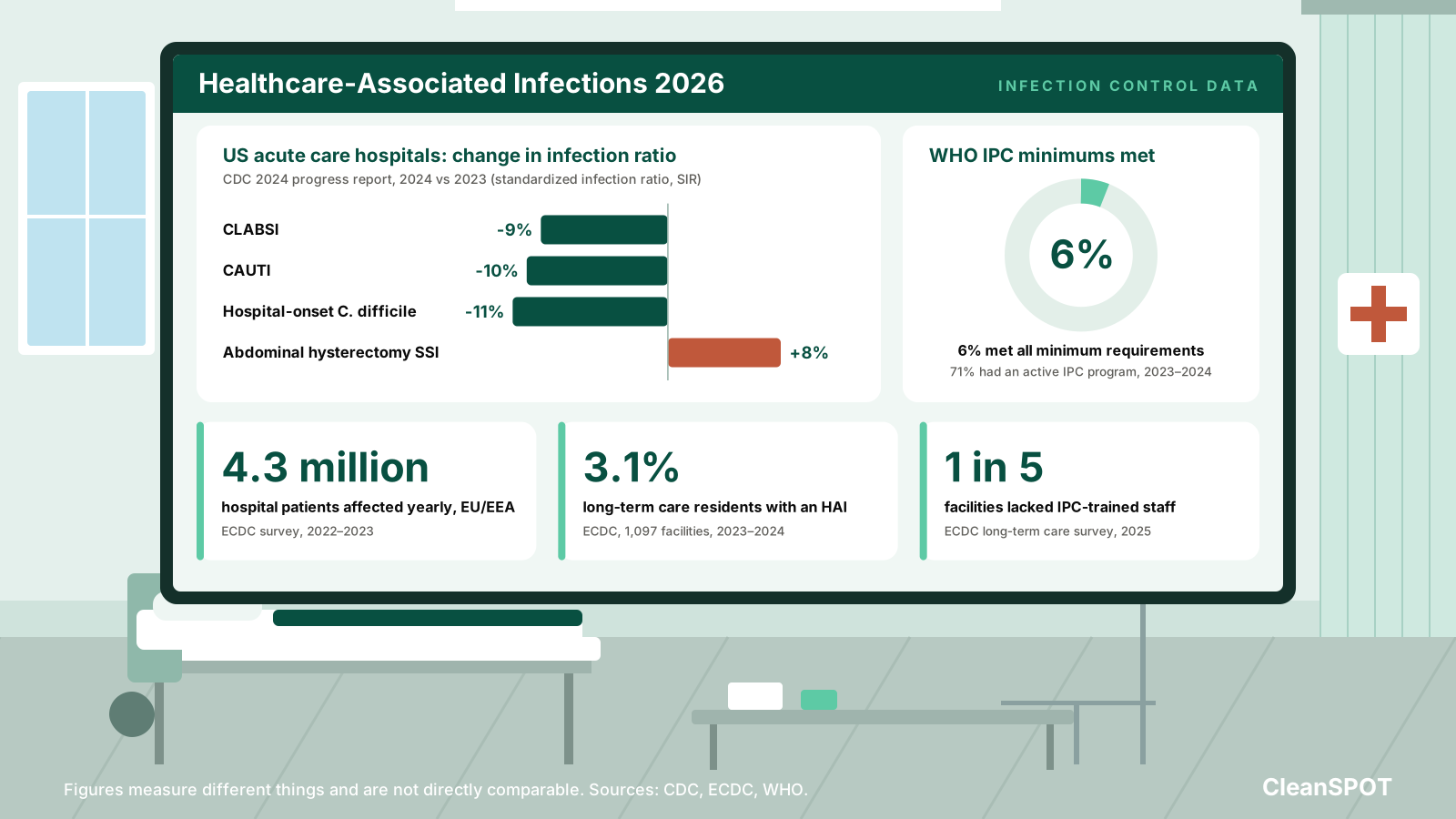
Healthcare-associated infections statistics show persistent gaps in prevention. Only 6% of countries met all WHO minimum infection prevention and control requirements in 2023–2024, according to the WHO’s 2024 findings. The ECDC estimates that 4.3 million patients acquire at least one healthcare-associated infection annually in EU/EEA hospitals, based on its 2022–2023 survey.
These figures measure different things. One assesses national programs, while the other estimates affected patients. For facility teams, the value comes from understanding the measure, identifying the relevant setting, and using local evidence to choose an action.
Environmental control is part of that work, alongside clinical practice, surveillance, and staff training.
- 9% lower central line-associated bloodstream infection (CLABSI) standardized infection ratio in US acute care hospitals in 2024 versus 2023. CDC 2024 progress report.
- 10% lower catheter-associated urinary tract infection ratio in the same comparison. CDC 2024 progress report.
- 11% lower hospital-onset C. difficile infection ratio in the same setting and period. CDC 2024 progress report.
- 8% higher abdominal hysterectomy surgical-site infection ratio in that comparison. CDC 2024 progress report.
- 4.3 million hospital patients affected annually is ECDC’s EU/EEA estimate based on its 2022–2023 survey. ECDC acute care findings.
- 3.1% of residents had at least one HAI in the surveyed European long-term care facilities at the time of assessment in 2023–2024. ECDC long-term care survey.
- 1,097 long-term care facilities in 18 countries contributed to that European survey. ECDC long-term care survey.
- One in five surveyed long-term care facilities lacked staff trained in infection prevention and control. ECDC’s May 2025 findings.
- 71% of countries had an active infection prevention and control program, according to WHO’s 2024 report. WHO report announcement.
- Only 6% met all WHO minimum IPC requirements in 2023–2024, according to the same announcement. WHO report announcement.
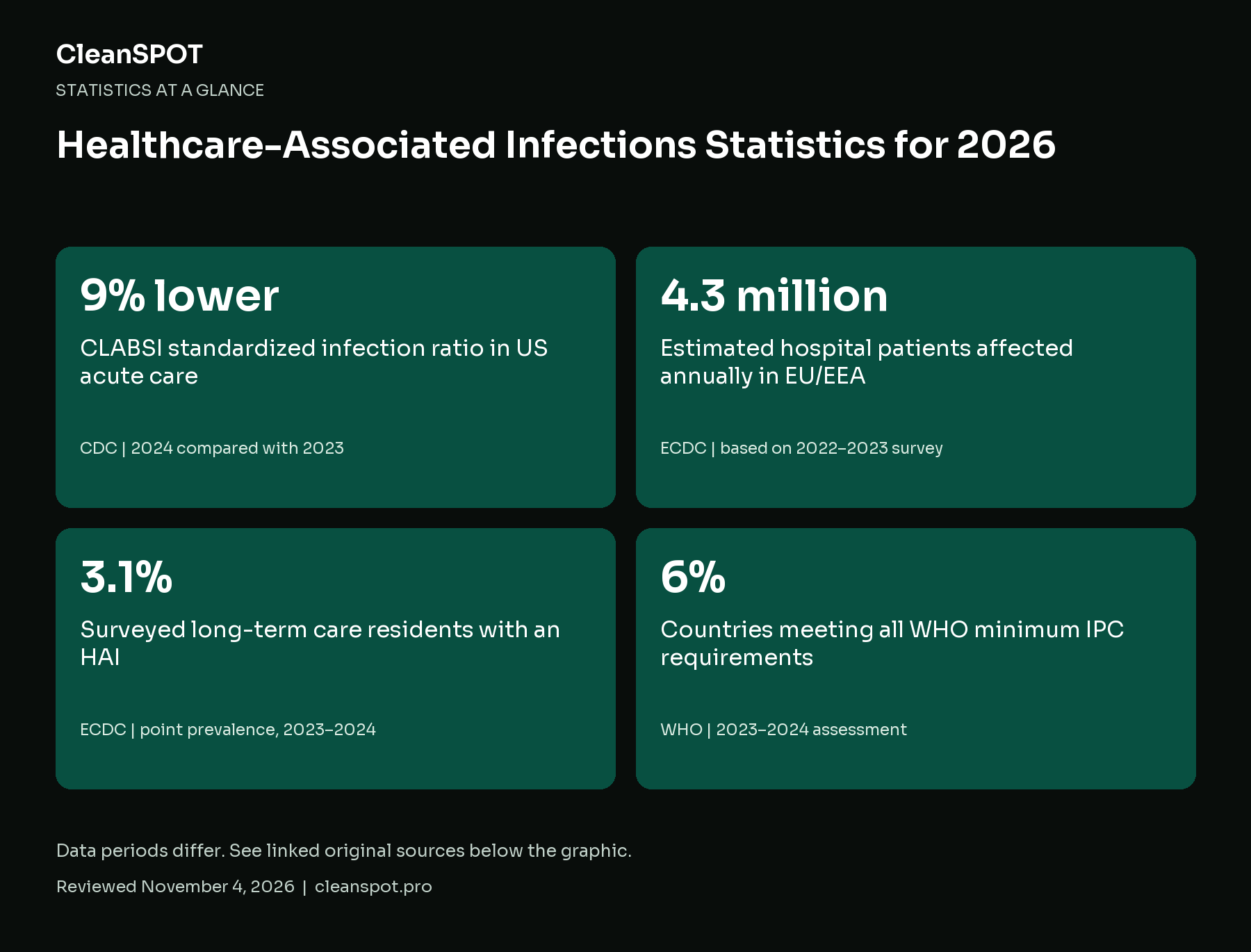
Graphic sources: CDC 2024 progress report · ECDC acute care findings · ECDC long-term care findings · WHO IPC findings
US Hospital Data Shows Uneven Progress
The CDC’s 2024 progress report covers several facility types and selected infection measures. Its acute care findings include lower ratios for multiple infection categories, with the increase for abdominal hysterectomy surgical-site infections standing out.
The lesson for a facility review is to keep infection categories separate. A favorable overall message can obscure a procedure-specific problem. Conversely, an increase in one category should not be described as a rise in every healthcare-associated infection.
The report does not attribute the national changes to one cleaning product, room-treatment method, or supplier. Do not use the decreases as evidence that a proposed piece of equipment will deliver the same improvement locally.
Understand the Standardized Infection Ratio
CDC defines the standardized infection ratio, or SIR, as observed infections divided by predicted infections. The report’s methods summary specifies a 2015 national baseline and risk-adjustment method for the figures discussed here.
An SIR is not the percentage of patients who became infected. A percentage change in that ratio is not a percentage-point change in patient risk, either. Preserve the original measure when writing a board paper or comparing reports.
For local review, ask the infection prevention team which definition, baseline, and reporting period applies. Do not combine results from different methods into a single trend line without checking whether the comparison is valid.
This matters when equipment is being evaluated. Establish which outcome the project could plausibly affect, then agree on how that outcome will be tracked. A room-treatment cycle record and a hospital infection rate belong in different parts of the evaluation.
European Hospital and Long-Term Care Figures Are Different Measures
The ECDC acute care findings describe a substantial annual burden in EU/EEA hospitals. Respiratory infections accounted for nearly a third of reported HAIs in the survey, and healthcare-associated COVID-19 contributed to the burden observed in 2022–2023.
That period matters when interpreting the results. Do not assume its mix of infections will match a different year, country, ward, or facility. Keep the population and survey period attached to the figure when using it as background.
The long-term care survey published in 2025 is a point-prevalence assessment. Its 3.1% finding describes residents with an HAI at the time of the survey, not the percentage who developed an infection over an entire year.
Separate Prevalence From Annual Risk
A snapshot and an annual count cannot be compared as though they have the same denominator. The population, observation period, and case definition must match the question being asked.
For example, a manager reviewing a long-term care cleaning program should not use an acute care annual estimate as a direct target for the home. The first task is to agree on a relevant local measure with the infection prevention team.
Write the measure out in full before shortening it for a dashboard. Include who is counted, when they are counted, and which infections qualify. This simple habit helps prevent a percentage from losing its meaning as it moves between reports.
Training Gaps Belong in the Facility Plan
The ECDC long-term care findings identified gaps in training and infection-control infrastructure. Nearly a third of surveyed facilities lacked a regular system for monitoring hand hygiene and giving staff feedback.
Those findings support a practical question before new equipment is purchased. Does the facility have people, time, procedures, and monitoring in place to operate the proposed system consistently?
A purchase can add a task as well as a capability. The project brief should identify who prepares the area, operates the equipment, reviews the record, investigates deviations, and authorizes return to use. Leaving those responsibilities undefined makes later performance reviews harder to interpret.
A Written IPC Program Is Not the Same as Full Implementation
The contrast between active programs and minimum requirements in the WHO 2024 findings shows why a policy document alone is an incomplete measure of readiness. A program needs resources and practical execution to influence day-to-day work.
For an internal assessment, separate what exists on paper from what staff can demonstrate. Review training records, access to supplies, reporting responsibilities, and the process for acting on a concern. Ask how a new staff member learns the procedure and how the team checks that it is being followed.
The CDC core infection prevention practices call for monitoring adherence, providing feedback, and acting on surveillance information. They place environmental cleaning alongside hand hygiene, injection safety, equipment reprocessing, and other standard precautions.
This prevents the environmental part of the program from becoming the entire explanation for infection prevention. A facility can improve room-treatment documentation while still needing separate work on clinical practices or device management.
Keep Process Evidence and Patient Outcomes Separate
Process evidence answers whether the agreed work was performed. Patient-outcome evidence addresses what happened to patients over the relevant period. Both are useful, but they should not be treated as interchangeable.
A completed treatment record does not prove that a patient infection was prevented. A fall in infections after an equipment change does not, by timing alone, prove that the equipment caused the fall.
Before evaluating a new control, identify other changes that could affect interpretation. Examples include changes in testing, patient population, staffing, or clinical procedures. Have the infection prevention team decide what information is needed for a fair assessment.
What the Data Means for Environmental Disinfection
The CDC guidance on healthcare surfaces recommends a coordinated environmental cleaning and disinfection program with defined responsibilities and monitoring. Equipment selection should sit inside that program rather than becoming a substitute for it.
The facility needs a defined target, suitable chemistry, an approved procedure, and a way to verify performance. A product name or visible mist cannot establish that the required treatment reached the necessary locations under the required conditions.
Our guide to sterilization versus disinfection explains why those endpoints must remain distinct. Room disinfection should not be described as sterilization without evidence supporting the complete process and its intended use.
Assess Fogging for the Specific Application
The CDC disinfection guideline clarification distinguishes older recommendations against routine disinfectant fogging from newer room-decontamination technologies. It does not provide a blanket endorsement of newer systems, and it identifies unresolved evidence questions.
That makes application-specific assessment necessary. The facility’s infection prevention and occupational-safety teams should review permitted use, chemical compatibility, exposure controls, preparation, aeration, and return-to-use criteria before approving a procedure.
Cleaning remains a separate task. The same CDC guidance requires careful cleaning before high-level disinfection or sterilization of patient-care items. A room-treatment proposal must state how surface preparation fits into the approved workflow.
When comparing proposals, ask for evidence tied to the actual delivery method and intended endpoint. Do not assume that evidence for one hydrogen peroxide process automatically applies to another device or application.
What Is New in the 2026 Reporting Picture?
The current US report was published in July 2026 and describes 2024 data. The European acute care and long-term care findings discussed here cover earlier survey periods, while WHO’s program assessment was published in 2024.
Those reporting lags do not make the sources unusable. They mean the article must label the period accurately and avoid presenting all numbers as events measured in 2026. Check the original report before moving any figure into a tender, business case, or training presentation.
For a local decision, use public statistics to establish context and local surveillance to investigate the facility’s problem. Record the chosen measure, responsible team, review period, and action thresholds before implementation begins.
Plan the Environmental System Around the Required Process
At CleanSPOT, we offer hydrogen peroxide fogging systems for compatible applications in regulated facilities, including laboratories. Share the room, intended use, required documentation, and operating constraints so we can assess an equipment configuration alongside your facility’s approved process.
- CDC, Environmental cleaning and disinfection guidance
- CDC, HAI progress report 2024
- CDC, Core infection prevention practices
- CDC, Disinfection and sterilization summary recommendations
- ECDC, HAIs in EU/EEA acute care hospitals
- ECDC, HAIs in long-term care facilities in Europe
- WHO, Global IPC report announcement (November 2024)
Share the room, intended use, required documentation and operating constraints so we can assess an equipment configuration alongside your approved process.
Request a quote