
Cannabis Climate Control: The Complete Guide
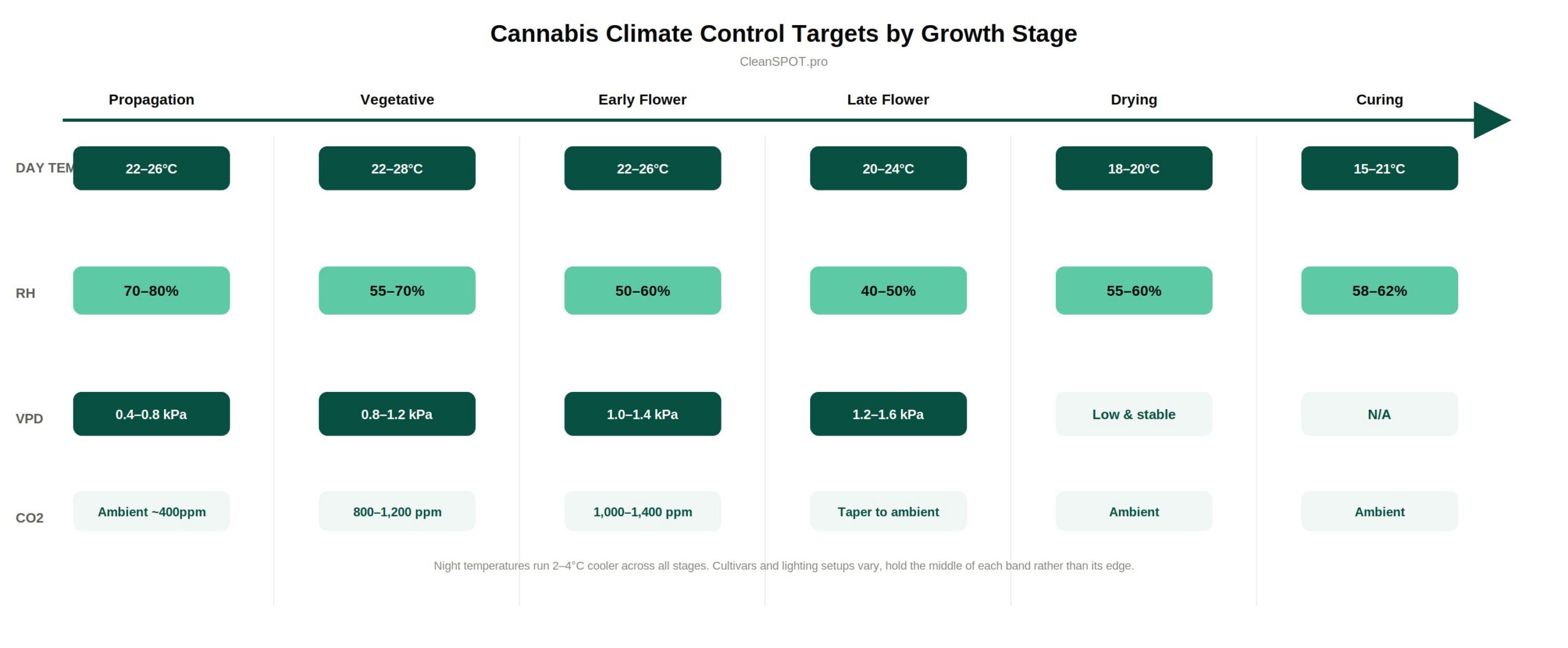
Cannabis climate control means holding four variables inside a narrow band at the same time: temperature, relative humidity, vapor pressure deficit, and CO2. Miss any one of them and the others stop working. Get all four right and you have consistent yields, intact terpenes, and a batch that passes testing.
At tent scale that is a thermostat and a fan. At facility scale it is an engineering problem, because a room full of plants is a machine that pumps water into the air all day and then stops at lights-out. This guide covers the target ranges by growth stage, why VPD is the number that actually matters, and the part no ranking guide addresses: what happens to those targets when you scale from a tent to a licensed room, and what an EU auditor expects you to be able to prove.
The Short Answer: Cannabis Climate Targets by Growth Stage
Every stage has its own climate. Propagation wants humid and still. Late flower wants dry and moving. Drying and curing are separate disciplines again.
| Stage | Day Temp | Night Temp | Target RH | Target VPD | CO2 |
|---|---|---|---|---|---|
| Propagation / clones | 22–26°C | 20–24°C | 70–80% | 0.4–0.8 kPa | Ambient (~400ppm) |
| Vegetative | 22–28°C | 20–24°C | 55–70% | 0.8–1.2 kPa | 800–1,200 ppm |
| Early flower | 22–26°C | 18–22°C | 50–60% | 1.0–1.4 kPa | 1,000–1,400 ppm |
| Late flower | 20–24°C | 18–20°C | 40–50% | 1.2–1.6 kPa | Taper to ambient |
| Drying | 18–20°C | Held flat | 55–60% | Low & stable | Ambient |
| Curing | 15–21°C | Held flat | 58–62% | N/A | Ambient |
Treat these as operating targets, not constants. Cultivars differ, and a room running high-intensity LEDs behaves differently from one running HPS. The ranges are where the industry converges, and the discipline is in holding them, not in naming them. Two things in that table are worth pausing on. RH does not simply fall as the plant matures, it has to be actively driven in both directions across the cycle. And the VPD column is not a derived curiosity. It is the column that explains the other two.
VPD: The Number That Actually Matters
Temperature and humidity are inputs. Vapor pressure deficit is what the plant actually feels.
VPD is the difference between the amount of moisture in the air and the amount the air could hold at saturation, measured in kilopascals. It determines transpiration rate: how hard the plant has to work to move water and dissolved nutrients from root to leaf. That single number governs nutrient uptake, stomatal behavior, and growth rate. The saturation vapour pressure it is derived from is standardised in the FAO’s Irrigation and Drainage Paper 56, which is the reference most horticultural VPD tables are ultimately built on, including the one below.
The reason VPD matters more than either input on its own is that identical RH readings mean completely different things at different temperatures.
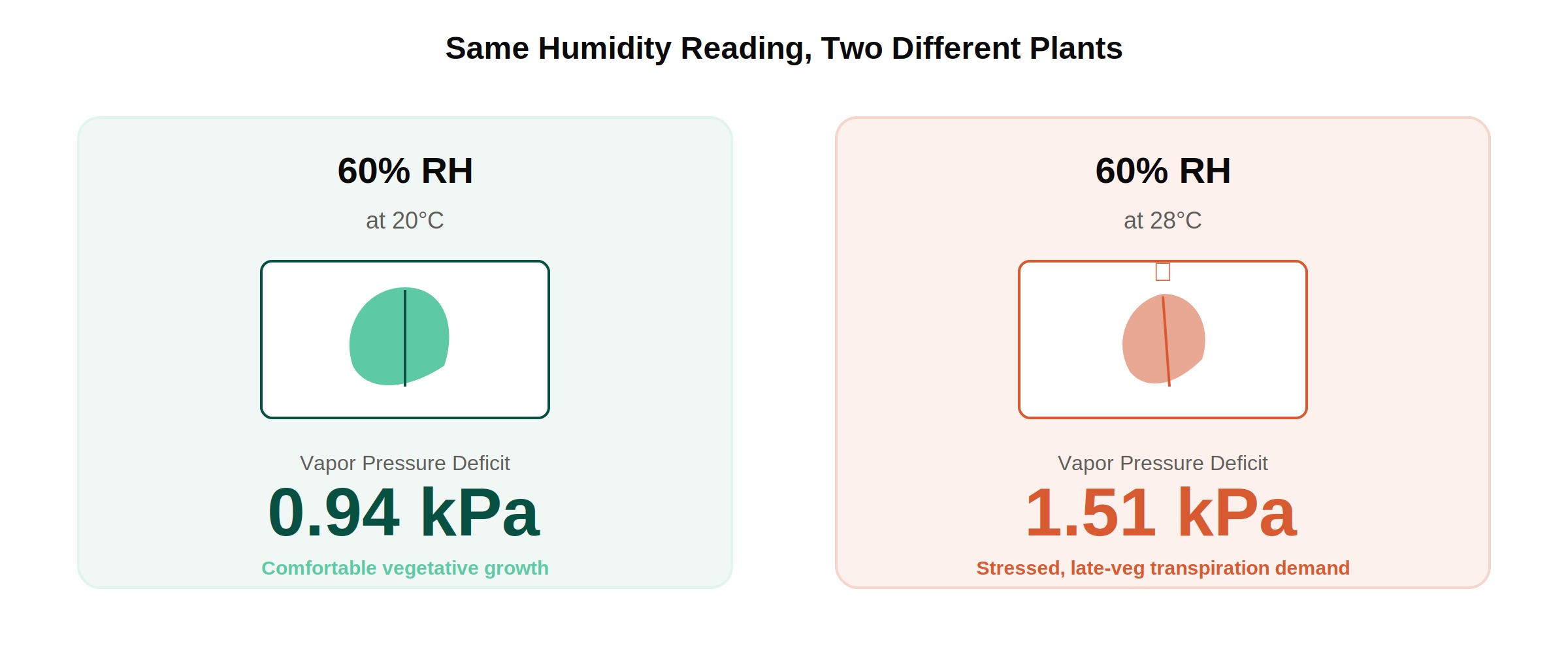
- 60% RH at 20°C gives a VPD of roughly 0.9 kPa. Comfortable for vegetative growth.
- 60% RH at 28°C gives a VPD of roughly 1.5 kPa. The same humidity reading, but the plant is now transpiring hard enough to stress in late veg.
Same RH. Nearly double the demand on the plant. A grower watching only a hygrometer sees no problem at all.
What goes wrong at each end:
- VPD too low (below ~0.4 kPa): transpiration nearly stops. The plant cannot pull calcium and other nutrients up through the xylem, so you get deficiency symptoms in a room that is fully fed. Guttation appears on leaf edges. Standing moisture on leaf surfaces invites pathogens.
- VPD too high (above ~1.6 kPa): the plant transpires faster than the roots can resupply. Stomata close defensively, photosynthesis stalls, and growth stops even with perfect light and nutrition. Sustained high VPD in flower degrades trichomes and volatilizes the monoterpenes that carry the aroma.
The practical takeaway: set VPD, then solve for temperature and humidity. Most facilities do the reverse, which is why their climate looks correct on a dashboard and their plants disagree.
VPD Chart: Temperature and Humidity to kPa
Use this to convert what your sensors report into what your plants experience. Find your air temperature down the left, your RH across the top, and read the VPD in kilopascals.
| Air Temp | 50% RH | 60% RH | 70% RH | 80% RH |
|---|---|---|---|---|
| 20°C (68°F) | 1.17 | 0.94 | 0.70 | 0.47 |
| 22°C (72°F) | 1.32 | 1.06 | 0.79 | 0.53 |
| 24°C (75°F) | 1.49 | 1.19 | 0.90 | 0.60 |
| 26°C (79°F) | 1.68 | 1.34 | 1.01 | 0.67 |
| 28°C (82°F) | 1.89 | 1.51 | 1.13 | 0.76 |
Read across the 60% RH column and the point makes itself: the same humidity reading produces 0.94 kPa at 20°C and 1.51 kPa at 28°C. One is comfortable vegetative growth. The other is a plant working hard enough to stress. One technical caveat that most VPD charts quietly skip: this table is air VPD, calculated from saturation vapour pressure at the air temperature. The figure the plant actually responds to is leaf VPD, and leaf surface temperature typically runs 1 to 2°C below air temperature under LED lighting, which lowers real VPD slightly against these numbers. If you are running an infrared leaf sensor, trust it over the chart. If you are not, treat this table as a close working approximation and stay in the middle of your target band rather than at its edge.
The Temperature That Grows the Most Plant Is Not the Temperature That Grows the Best Flower
This is where published research and commercial practice openly disagree, and it is worth understanding why.
Measured purely on gas exchange, cannabis photosynthesis peaks warm. In the most widely cited study of the plant’s photosynthetic response, Chandra and colleagues recorded the maximum rate of photosynthesis at 30°C under 1,500 μmol·m⁻²·s⁻&sup9; PPFD, with the response falling away above that light level and at higher temperatures. A follow-up study across drug and fiber varieties found the same broad pattern.
So why does every commercial flowering room in Europe run 6 to 10°C cooler than that?
Because peak leaf photosynthesis is not the objective. Marketable flower is the objective, and the terpenes that determine its market value are volatile organic compounds that evaporate under heat. A room held at 30°C through flower will photosynthesize efficiently and produce biomass that tests lower on total terpenes and smells like less than it should. You are trading the part of the plant that is measured in grams against the part that is measured in price per gram.
The light side of that trade is real, though. Cannabis yield rises linearly with light intensity from 120 all the way to 1,800 μmol·m⁻²·s⁻&sup9;, with no saturation point inside any practical production range, which is unusual among indoor crops. That is the finding that justifies high-intensity lighting, and it is also the finding that creates the climate problem: a room lit hard enough to exploit that linear response is a room with an enormous heat and transpiration load to manage.
The resolution most quality-focused facilities land on: run the light high, hold the temperature moderate, and use CO2 and VPD to recover the photosynthetic capacity you gave up by staying cool. That only works if the climate system is precise enough to hold the setpoint under that load.
Stage by Stage: What Each Phase Demands
Propagation and clones
Cuttings have no root system. They cannot replace water, so the only way to keep them alive is to stop them losing it: high humidity, low VPD, minimal air movement. This is the one stage where the entire climate strategy is adding moisture, and it is the stage most commonly lost to an over-aggressive HVAC system that treats humidity as something to be removed. A room that dries out overnight kills a tray of clones by morning.
Vegetative
Roots are established, so you raise VPD to drive transpiration and growth. This is where CO2 enrichment starts paying for itself, because a plant transpiring properly under strong light can use more carbon than ambient air supplies. Enrichment much above 1,200 ppm gives diminishing returns unless light intensity is genuinely high enough to support it, and it is wasted money in a room that is light-limited.
Flowering
The climate tightens. Temperature comes down to protect terpenes, RH comes down to protect the flower, and VPD rises. The last two to three weeks are the highest-risk period in the entire cycle: the canopy is dense, airflow through it is poor, and the buds themselves are now the moisture-holding mass. Microclimates form inside the canopy that a wall-mounted sensor never sees. If you monitor climate from one point in the room during late flower, you are monitoring the wrong place.
Drying
Drying is not “storage with a fan.” It is the first half of a continuous moisture-control process that ends in curing. The widely used benchmark is the 60/60 rule: hold the room near 60°F and 60% RH so moisture leaves the flower slowly and evenly, typically over 7 to 14 days. Rush it with heat or low humidity and you lock chlorophyll into the flower, which produces the grassy, harsh character that no cure will fully repair. Drag it out at high humidity and you invite mold before curing ever begins.
Curing
The target is 58 to 62% RH, held for two to eight weeks. This is where the terpene profile stabilizes and harsh compounds break down. The endpoint an auditor and a lab actually care about is water activity, not ambient RH: ASTM D8197 specifies maintaining dry cannabis flower between 0.55 and 0.65 aw, which corresponds closely to equilibrium at 58 to 62% RH. We covered the full engineering of this stage in our guide to cannabis curing humidity.
The Four Levers, and Which Ones You Actually Control
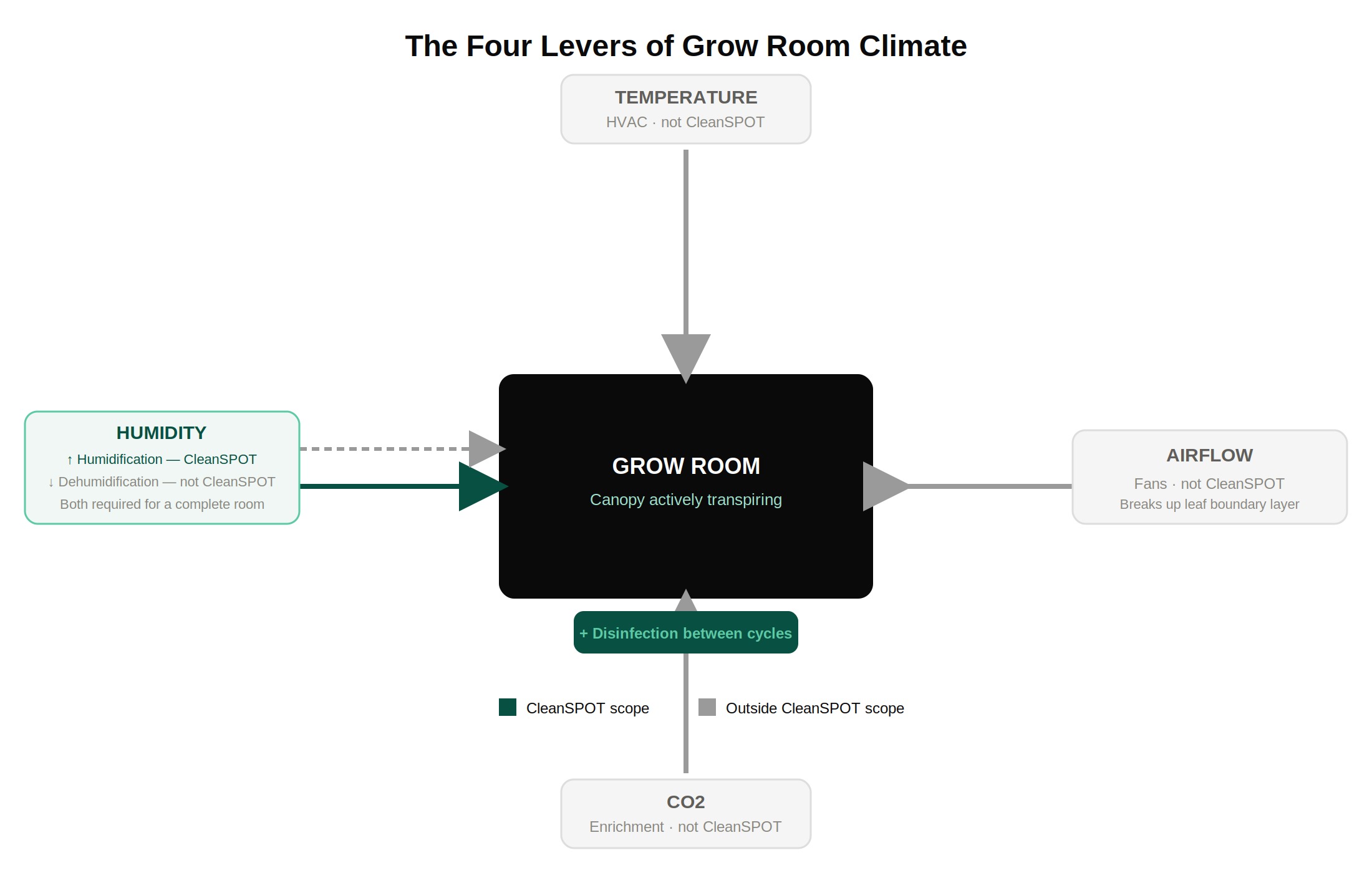
Climate control is four systems that have to agree with each other.
- Temperature. Handled by HVAC. The complication is that your lights are also a heater, so the room’s thermal load swings hard between lights-on and lights-off, and the HVAC has to track that swing without dragging humidity along with it.
- Humidity, in both directions. This is the lever most facilities get half right. Removing moisture is a dehumidification problem. Adding it back, and holding a setpoint rather than overshooting past it, is a humidification problem. They are different pieces of equipment and both are required. To be direct about our own scope: CleanSPOT builds humidification and disinfection systems, not dehumidifiers. A complete room needs both, and any supplier who tells you their half of that is the whole answer is selling, not engineering.
- Airflow. Air movement breaks up the boundary layer of still, saturated air that forms on the underside of every leaf. Without it, the leaf sits in its own microclimate and your room-level VPD reading becomes fiction. Airflow is also the reason late flower is dangerous: a dense canopy blocks it exactly when you need it most.
- CO2. Only worth enriching when light and VPD are already correct. CO2 is the last lever, not the first. Enriching a room where the plants have closed their stomata against high VPD is spending money to feed a plant that has stopped eating.
Where Commercial Climate Control Actually Breaks Down
Every guide ranking for this topic is written for someone with a tent, a hygrometer, and a humidifier from a hardware store. That advice is correct at that scale and it does not survive contact with a licensed room.
Here is what changes. The plants are the biggest moisture source in the building. A mature canopy transpires the majority of the water it is given straight back into the air. A room holding several hundred plants can put tens of litres of water into the air per day. Your climate system is not managing a static room, it is managing a machine that is actively fighting it.
The load is not constant, and that is the real problem. Lights come on and transpiration ramps up hard. Lights go off and it collapses. Your HVAC, still pulling moisture on the same schedule, now overshoots the room dry. There is no floor under the RH, because dehumidification and air conditioning have no mechanism to put moisture back. The room drifts below target, VPD climbs past 1.6 kPa overnight, and you find stressed plants in the morning with a climate log that shows the temperature was perfect the whole time.
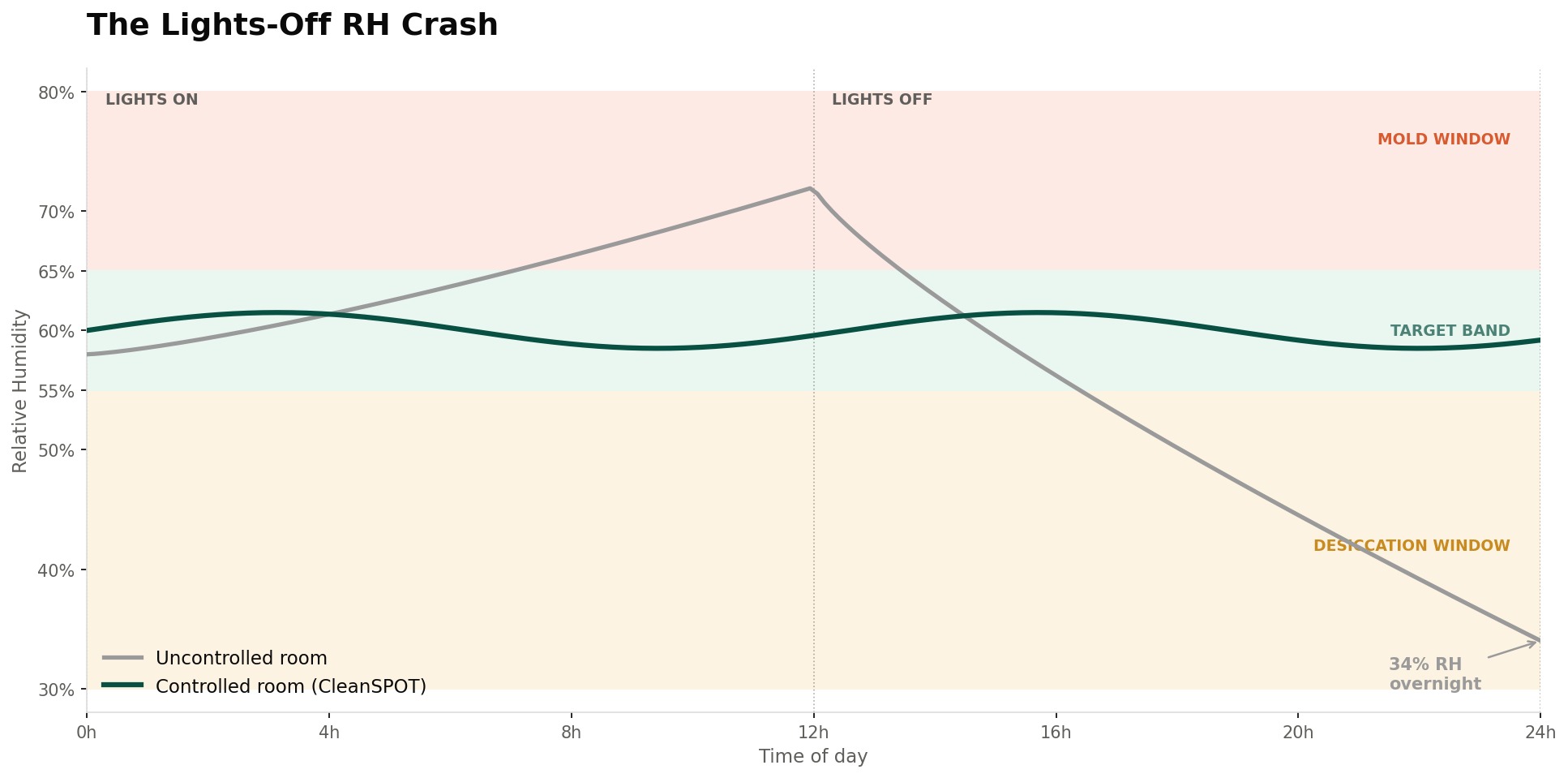
Averages lie. A room that averages 55% RH while swinging between 40% and 70% is not a room at 55% RH. It is a room that spent part of every day in the mold window and the rest of it desiccating your flower. Plants respond to the extremes, not to the mean. This is the single most common failure in commercial cultivation data, and it is invisible unless you are logging continuously.
The consequence: at facility scale, precision humidification is not a nice-to-have, it is the missing half of the system. Dehumidification handles the high side. Humidification holds the low side and, more importantly, holds a stable setpoint instead of letting the room oscillate between the two extremes.
This is what industrial ultrasonic humidifiers are built to do. Ultrasonic humidification uses high-frequency vibration to convert water into a 1µm mist rather than boiling it into steam, so it adds moisture without adding a heat load to a room you are already struggling to cool. CleanSPOT systems hold RH to within ±1 to 2%, continuously, which is the tolerance that keeps a room genuinely inside its target band rather than averaging into it. For facilities managing climate through the air handling system, duct and AHU humidifiers deliver the same precision from 35 to 280 L/h across a larger footprint.
Three details matter specifically for a consumable crop:
- The humidifier cannot become a contamination source. Our units run on reverse osmosis water and carry a built-in UVC LED that continuously disinfects the unit’s own water supply. A humidifier feeding untreated water into a flowering room is a microbial risk with a power cable.
- Material specification. Stainless steel 304/316L construction, not consumer-grade plastic, because a regulated facility gets inspected.
- Multi-room coordination. Master and slave control runs separate RH targets for propagation, veg, flower, dry, and cure rooms from a single point, with WiFi or full BMS integration.
Climate Control Is a Compliance Document
This is the section every competing guide leaves out, and it is the one a commercial reader is actually being judged on.
For EU cultivators, climate is not just an agronomic input. It is evidence. The EMA’s guideline on Good Agricultural and Collection Practice governs the cultivation and primary processing of starting materials of herbal origin, which is where a cannabis grow room sits. Once the crop moves into processing and manufacture, it falls under EU-GMP, set out in EudraLex Volume 4. Both expect you to demonstrate that your environmental conditions were controlled, not merely that you intended them to be.
Those two terms are used interchangeably across cannabis marketing and they are not interchangeable. Cultivation sits under GACP. What happens after harvest moves under EU-GMP. Getting that distinction right in front of an auditor is a credibility test in itself.
What it means in practice:
- Continuous logging, not spot checks. A clipboard reading taken twice a day proves nothing about the eight hours in between, which is exactly where a lights-off RH crash lives.
- Alarms and deviation records. An auditor wants to see that an excursion was detected, recorded, and acted on. A room that never records a deviation is not a well-controlled room, it is an unmonitored one, and an experienced auditor knows the difference.
- BMS or SCADA integration. Equipment that reports into the building management system produces the audit trail automatically. Standalone units that hold their data on a front panel produce a monitoring blind spot.
This is why we build for BMS and SCADA integration rather than shipping standalone boxes. Full integration is also what makes the precision worth having: a ±1 to 2% RH tolerance you cannot evidence is an engineering claim, not a compliance one.
The precision requirement is not theoretical. Alkaloid AD in Skopje, one of the largest pharmaceutical producers in Europe, runs CleanSPOT HVAC ultrasonic systems at 84 L/h and 50 L/h in Class C clean rooms. Cannabis facilities are held to a comparable standard of environmental evidence, and increasingly by the same auditors.
Sanitation Between Cycles
Climate control does not end when the room empties. A grow room between cycles is a warm surface waiting for the next pathogen, and manual spraying reaches the surfaces a person can reach, which is not the same thing as the surfaces that matter.
Our hydrogen peroxide fogging distributes H2O2 as an ultrasonic fog that reaches ductwork, ceilings, and the gaps between benches. Combined with UVC, it resets the room’s microbial load between cycles and reduces operator chemical exposure at the same time. Powdery mildew and botrytis that survive a turnaround in the ductwork will find the next crop, and no amount of in-cycle climate precision undoes a contaminated starting point.
Specifying a System: Do the Math Before You Buy
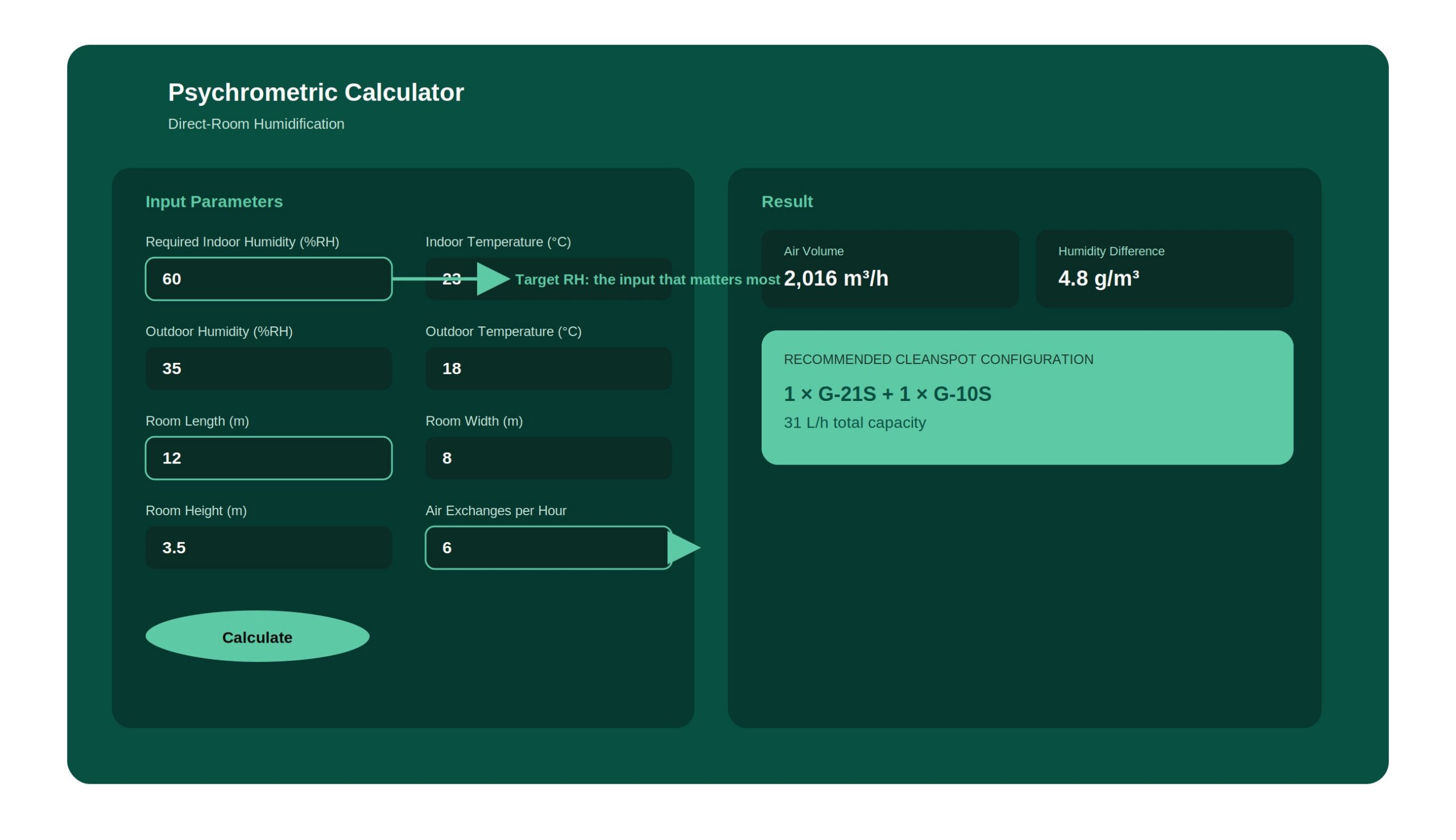
The most expensive climate mistake is equipment sized by guesswork. Sizing depends on room volume, target RH, incoming air condition, air changes per hour, and the transpiration load of a full canopy, and those inputs interact.
Our psychrometric calculator works the absolute humidity difference between your current and target conditions and returns a recommended system configuration. Run it before you talk to any supplier, including us. A grower who arrives with a load figure has a specification conversation. A grower who arrives without one has a sales conversation.
Cannabis Climate Control FAQ
Is 80 degrees too hot for cannabis plants?
Not by itself. 80°F (27°C) sits at the top of the acceptable vegetative range and is usually fine if VPD stays in band and CO2 is enriched. It becomes a problem in late flower, where sustained temperatures at that level volatilize terpenes and degrade trichomes. Judge the temperature by the VPD it produces at your current RH, not by the number alone.
At what temperature does cannabis stop growing?
Growth slows sharply below roughly 15°C (59°F) and above roughly 30°C (86°F). At the high end the plant closes its stomata to defend against water loss, which halts photosynthesis regardless of how much light and CO2 you supply. The plant has not run out of resources, it has stopped being able to use them.
What is the 60-60 rule for drying cannabis?
Hold the drying room near 60°F and 60% RH. Under those conditions most cultivars reach the correct moisture endpoint in roughly 7 to 14 days, slowly enough to preserve terpenes and avoid locking chlorophyll into the flower.
What is the ideal VPD for cannabis?
Roughly 0.4 to 0.8 kPa in propagation, 0.8 to 1.2 kPa in vegetative growth, and 1.0 to 1.6 kPa through flowering, rising as the plant matures. VPD is a function of temperature and humidity together, which is why two rooms with identical RH readings can present completely different conditions to the plant.
Do I need a humidifier in a cannabis grow room, or just a dehumidifier?
Both. Dehumidification handles the moisture the canopy releases during lights-on. Humidification handles propagation, and it handles the lights-off period when transpiration stops and an HVAC system left running will pull the room well below target. A room with only dehumidification has no floor under its RH.
The Takeaway
Cannabis climate control is not four separate settings. It is one system where temperature, humidity, VPD, CO2, and airflow either agree with each other or quietly undermine each other. The targets are not hard to name, and every guide on this topic names them. Holding those targets in a real room, against a canopy that is actively pumping water into the air on a twelve-hour cycle, is the part that separates a facility with consistent, test-passing output from one that loses batches to a room it cannot control. If you are building or upgrading a cultivation facility and want the humidity side of that system specified properly, talk to a CleanSPOT engineer about a configuration sized to your rooms.
Run the numbers in our psychrometric calculator, then talk to an engineer about your configuration.
Request a quote