
What Is a Clean Room?
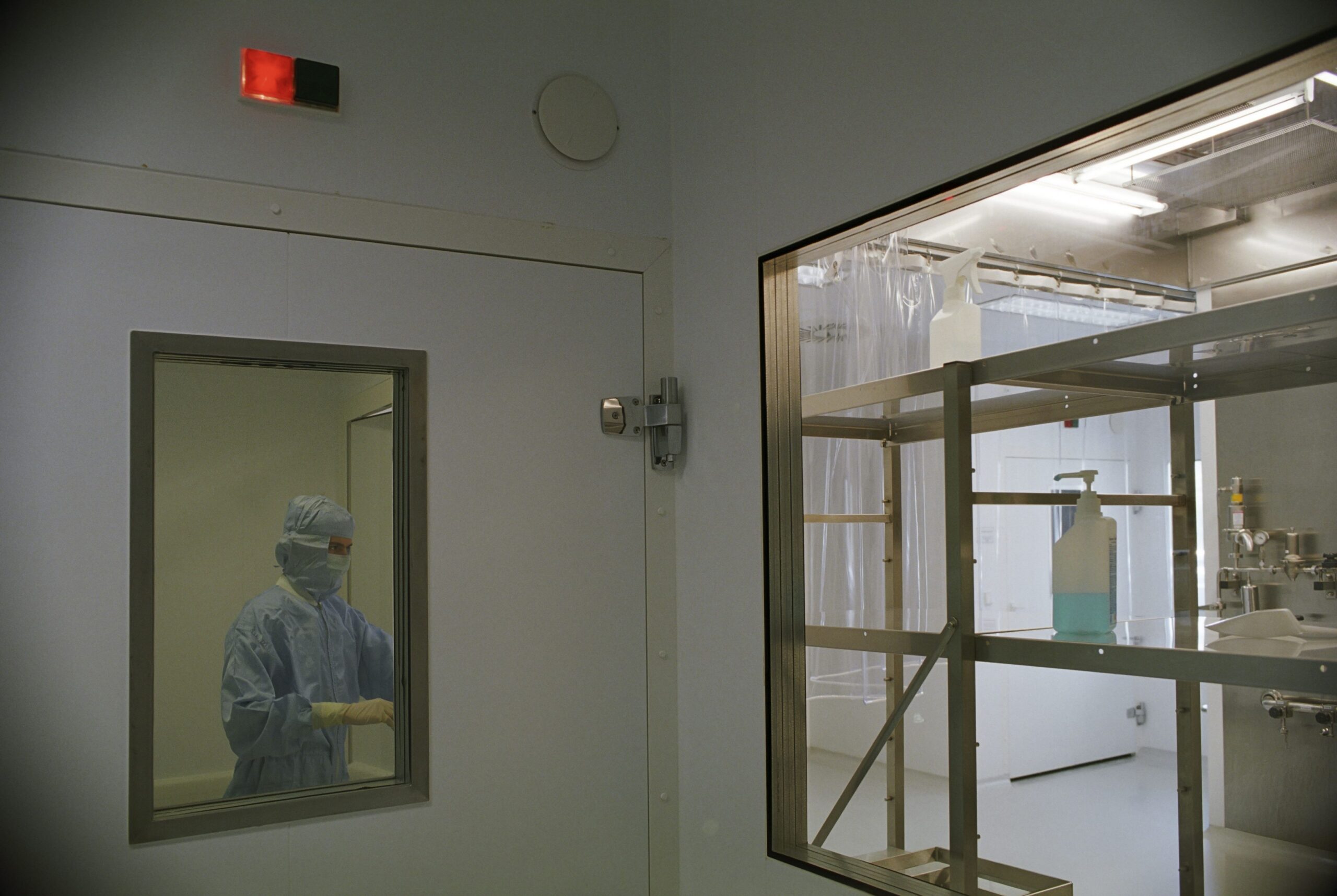
A clean room is an enclosed, engineered environment in which the concentration of airborne particles is held below a defined limit, and in which temperature, humidity, pressure and airflow are controlled to keep it there. It is not simply a room that gets cleaned thoroughly. It is a room whose air is continuously filtered, replaced and monitored against a numerical standard, and which is only a clean room for as long as it measurably meets that number.
That distinction matters more than most introductions to the subject admit. A clean room is defined by a measurement, not by a fit-out. The panels, the coving, the interlocked doors and the gowning airlock all exist to serve one outcome: a particle count that stays inside its class while people are working in it.
This guide covers what a clean room controls, how clean rooms are classified under ISO 14644-1 and EU GMP, the engineering that holds a class in place, and one variable that governs whether a room holds its particle count in practice but appears nowhere in its classification: relative humidity.
What a Clean Room Actually Controls
The headline parameter is airborne particulate. Everything else in the specification is downstream of it.
Particles are not an abstraction here. In a sterile pharmaceutical suite, a particle is a potential carrier for a viable organism. In a semiconductor fab, a particle landing on a wafer is a dead die. In a cannabis processing room operating to GMP, a particle is a contamination event on a product that will be tested and released against a specification. The number on the wall is a proxy for product risk.
A clean room controls four contamination sources at once:
- Air. Supply air is filtered through HEPA or ULPA filters and delivered at a high air change rate, so that particles generated inside the room are diluted and swept out faster than they can accumulate.
- People. Personnel are the dominant particle source in almost every clean room. A gowned operator still sheds. An ungowned one sheds enormously. Gowning, airlocks and movement discipline exist to manage this.
- Surfaces and materials. Finishes are chosen to be non-shedding and cleanable. Coving eliminates the corners that trap particulate. Materials entering the room pass through pass-throughs or material airlocks.
- The process itself. Powder handling, milling, and trimming all generate particulate. The room has to be designed around what will actually happen inside it.
Pressure cascades tie these together. A cleaner room is held at positive pressure relative to a less clean adjacent space, so that any leakage flows outward, from clean to less clean, rather than inward. Where the hazard is the product itself rather than contamination of it, for example a potent compound or a biological agent, the cascade can be deliberately reversed to contain it.
How Clean Rooms Are Classified: ISO 14644-1
The international standard is ISO 14644-1, which classifies air cleanliness by particle concentration. It defines nine classes, ISO 1 through ISO 9, where a lower number means cleaner air. Each class sets a maximum permitted number of particles per cubic metre of air at a range of particle sizes.
The 0.5 micron threshold is the one most commonly quoted, since it’s the size at which most classes are verified in practice. ISO 1 and ISO 2 are classified at smaller particle sizes, 0.1 to 0.3 micron, because at those cleanliness levels the 0.5 micron count is too low to measure reliably.
| ISO Class | Max particles ≥0.5µm per m³ | Rough equivalent |
|---|---|---|
| ISO 1 | Not specified at this size | Cleanest achievable |
| ISO 2 | Not specified at this size | Semiconductor research |
| ISO 3 | 35 | Old Class 1 |
| ISO 4 | 352 | Old Class 10 |
| ISO 5 | 3,520 | Old Class 100 |
| ISO 6 | 35,200 | Old Class 1,000 |
| ISO 7 | 352,000 | Old Class 10,000 |
| ISO 8 | 3,520,000 | Old Class 100,000 |
| ISO 9 | 35,200,000 | Room air |
For scale: ordinary indoor air sits at roughly ISO 9. An ISO 8 room is around ten times cleaner than that. An ISO 5 room, the standard for open aseptic processing, is roughly ten thousand times cleaner than the room you are probably sitting in. You will still hear “Class 100” or “Class 10,000,” these come from US Federal Standard 209E, cancelled in November 2001 and superseded by ISO 14644. If a supplier quotes FED-STD-209E classes, translate to ISO before you sign anything. One more point routinely missed: classification is stated against an occupancy state, as-built, at-rest, or in-operation. A classification quoted without its occupancy state is not a specification, it is a marketing claim.
EU GMP Grades A, B, C and D
Pharmaceutical manufacturers in Europe work to a second, overlapping system: the grades defined in EudraLex Volume 4, Annex 1, the EU GMP guideline for sterile medicinal products. Grades map onto ISO classes, but each carries a requirement in two occupancy states.
| EU GMP Grade | At rest | In operation | Typical use |
|---|---|---|---|
| Grade A | ISO 5 | ISO 5 | Critical zone, aseptic filling |
| Grade B | ISO 5 | ISO 7 | Background to Grade A |
| Grade C | ISO 7 | ISO 8 | Less critical preparation stages |
| Grade D | ISO 8 | Not defined | Support and early-stage handling |
Grade A is the demanding one, because it must hold ISO 5 with people and process running inside it, achieved with unidirectional airflow at a guidance velocity of 0.36 to 0.54 m/s at the working position.
Annex 1 also does something ISO 14644-1 does not: it sets requirements for microbial contamination, and it sets expectations for temperature and humidity. ISO 14644-1 is silent on both. That’s the hinge of this article.
How a Clean Room Stays Clean
Four mechanisms, working together.
- Filtration. HEPA filters remove at least 99.97% of particles at 0.3 micron, the most penetrating particle size. ULPA filters go further. Every cubic metre of supply air passes through them.
- Air change rate. The dilution engine. Typical design practice runs roughly 10–25 air changes per hour for ISO 8, 30–60 for ISO 7, and 90–180 for ISO 6. ISO 5 and cleaner generally require unidirectional airflow instead.
- Airflow pattern. Non-unidirectional (turbulent) airflow mixes and dilutes. Unidirectional (laminar) airflow sweeps particles out of the critical zone before they can settle on product, and is reserved for where it’s genuinely needed.
- Pressure and people. The cascade holds the boundary. Gowning holds the operator. Neither is optional.
Notice what all four have in common: they’re all about moving large volumes of heavily filtered air, very fast, all the time. That has a consequence almost nobody writes about.
The Variable Your ISO Class Does Not Cover: Humidity
Here’s the thing that surprises facility managers who inherit a room rather than commission one.
An ISO class is a particle specification. It is not a climate specification. You can hold ISO 7 at 20% RH and you can hold ISO 7 at 55% RH. Both rooms pass classification. They are not the same room, and they will not perform the same way.
The reason clean rooms trend dry is structural. A clean room pushes a large volume of make-up air through heating and filtration at a high change rate. Heated air holds more moisture than cold air, so the same absolute moisture content produces a far lower relative humidity once it’s warmed. Run that at 40 air changes per hour through a European winter and the room will sit at very low RH unless moisture is deliberately added back. The cleaner the room, the harder the air is worked, and the drier it gets. Cleanliness and dryness are linked by the design itself. Most operations target somewhere between 30% and 60% RH, and many pharmaceutical operations hold a considerably tighter band than that, and not for comfort.
What Goes Wrong When Clean Room Humidity Drops
Static charge, and the particles it holds. Below roughly 30% RH, triboelectric charging climbs sharply. Surfaces, garments, tools and product accumulate electrostatic charge, and charged surfaces attract and hold airborne particulate. ESD Association guidance treats humidity above 30% RH as a baseline condition for an ESD-protected area, and notes that some ESD-protective materials become ineffective, or become charge sources themselves, in dry conditions.
Read that against what a clean room is for. The room’s entire purpose is to keep particles away from product. Let the air get dry enough and you build an electrostatic mechanism that actively pulls particles onto the exact surfaces you’re protecting, inside a room whose particle counter may still report a passing number, because the particles are no longer airborne. They’re on your product.
Operator shedding. EU GMP Annex 1 is unusually direct here, stating that ambient temperature and humidity should be set to prevent shedding due to operators becoming too cold or too hot. The regulator has explicitly connected the room’s humidity setpoint to its particle burden, through the largest particle source in the room, the person standing in it.
Product and process damage. In pharmaceutical powder handling, dry air makes fine powders charge, clump and stick to equipment, affecting yield and dose uniformity. In cannabis processing operating to GMP, low humidity degrades trichomes and drives moisture loss that shows up directly as lost saleable weight. In laboratories, dry air destabilises sensitive instruments and reference materials. In food production, it accelerates desiccation and product weight loss.
None of these failures show up as a classification failure. The room passes. The product does not.
How Clean Room Humidity Is Controlled
Humidity in a clean room is added back into the air stream, either centrally in the air handling unit or locally in the room itself.
Central humidification, through duct and AHU humidifiers, treats supply air before it reaches the room. It’s the right approach where a single AHU serves a suite and a uniform setpoint is acceptable. In-room industrial ultrasonic humidifiers treat the space directly, which suits rooms with an individual setpoint, a high local moisture load, or a retrofit where the AHU can’t be touched.
Ultrasonic humidification is well suited to controlled environments for a specific engineering reason. A piezoelectric transducer atomises water into a droplet on the order of 1 micron, which absorbs into the air stream almost immediately rather than falling out as wetting. There’s no boiler, no steam, and no significant heat load added to a room you’re already spending money to cool. Control resolution matters as much as capacity: holding ±1 to 2% RH is a very different proposition from holding ±10%, and in a validated environment the tolerance is the specification.
Water treatment is not an afterthought here. Any humidifier feeding a classified space is introducing something into that space. The water treatment stage is part of the contamination control strategy, not a utility detail, and it should be documented as such.
Sizing is a psychrometric calculation, not a guess. Room volume, air change rate, supply air condition, target RH and internal moisture gains all feed into the moisture load. CleanSPOT publishes a psychrometric calculator that runs the sizing directly.
For a worked example of climate control designed as a room-scale engineering problem rather than a comfort setting, see our guides to cannabis climate control and cannabis curing humidity.
In practice: Alkaloid AD Skopje, one of Europe’s largest pharmaceutical producers, specified two HVAC ultrasonic humidification units from CleanSPOT, rated at 84 L/h and 50 L/h, for Class C clean rooms. That’s the scale of moisture a GMP-graded suite consumes once it’s running. More detail on installations of this type is in our case studies.
Decontamination Between the Particles
Particle control and microbial control are related but not identical problems. Filtration handles what’s airborne. It does not disinfect a surface.
For sterile and GMP-graded environments, surface bio-decontamination is typically handled by fogging a room with vaporised hydrogen peroxide, which reaches surfaces, shadowed geometry and equipment that manual cleaning cannot reliably cover, then breaks down into water and oxygen with no residue to validate away. This is standard practice for room turnover, changeover between batches, and post-maintenance recovery. CleanSPOT’s hydrogen peroxide fogging systems are built for exactly this duty.
Where Clean Rooms Are Used
- Pharmaceutical manufacturing. Sterile production, aseptic filling, powder handling and packaging, working to EU GMP Grades A to D.
- Cannabis cultivation and processing. EU-GMP graded processing, extraction and packaging suites for medical cannabis, where the product is a pharmaceutical and is regulated as one.
- Laboratories and research. Analytical labs, metrology, cell culture and any environment where the measurement is more sensitive than the room.
- Food production. High-care and high-risk zones, where the standard is driven by microbial control and shelf life.
- Semiconductors and electronics. The most demanding class levels in existence, and the industry where the humidity and static relationship was understood first.
Clean Room FAQ
What is considered a clean room?
A room that meets a defined airborne particle limit under a recognised standard, most commonly ISO 14644-1, and maintains that limit continuously through filtration, controlled airflow and pressure control. Thorough cleaning alone does not make a room a clean room.
What is the purpose of a clean room?
To protect a product, a process or a measurement from contamination that would compromise it, patient safety and batch integrity in pharma, yield in semiconductors, result validity in labs.
What is the difference between a cleanroom and a clean room?
Nothing technically. Both spellings refer to the same thing. “Cleanroom” as one word is more common in manufacturing and standards documents, “clean room” as two words appears more often in scientific and general usage.
What is not allowed in a clean room?
Anything that sheds, retains or generates particulate: ordinary paper and cardboard, cosmetics, jewellery, exposed skin and hair, and personal electronics in the higher grades. Everything entering does so through a defined pass-through or airlock.
What are the ISO clean room classes?
ISO 14644-1 defines nine classes, ISO 1 through ISO 9, based on maximum permitted airborne particle concentration per cubic metre. ISO 5, 7 and 8 are most commonly encountered in pharmaceutical and food environments.
Do ISO clean room standards specify temperature and humidity?
No, ISO 14644-1 classifies air cleanliness by particle concentration only. In EU pharmaceutical manufacturing, GMP Annex 1 does address temperature and humidity, including preventing operator shedding.
What humidity should a clean room be kept at?
No single answer, it depends on the product and process. Most controlled environments operate between 30% and 60% RH, with the lower bound largely driven by electrostatic control below roughly 30% RH.
Why do clean rooms get so dry?
Because a clean room moves a large volume of heated, filtered make-up air at a high change rate. Warming air raises its capacity to hold moisture, driving relative humidity down even when absolute moisture content is unchanged.
How is humidity added to a clean room?
Centrally through the AHU/duct, or locally through in-room units. Ultrasonic humidification is widely used since it adds no heat load and can hold a tight RH tolerance, sized psychrometrically from room volume, air change rate, and target RH.
What is the difference between an ISO class and an EU GMP grade?
An ISO class is a particle count limit. An EU GMP grade includes a particle limit in two occupancy states plus microbial limits and environmental requirements ISO 14644-1 doesn’t cover. A room can meet an ISO class and still fail GMP.
The Short Version
A clean room is a controlled environment where airborne particulate is held below a defined limit, classified under ISO 14644-1 from ISO 1 to ISO 9, and, in European pharmaceutical manufacturing, graded A to D under EU GMP Annex 1. It stays clean through HEPA filtration, high air change rates, engineered airflow patterns, pressure cascades and gowned personnel discipline.
And it stays clean in practice only if the humidity is right. The ISO class won’t tell you that, because the ISO class doesn’t measure it. If you’re commissioning, inheriting or troubleshooting a controlled environment, the particle count tells you whether the room is compliant. The humidity tells you whether it’s working. If you want the moisture load for a specific room sized properly, talk to our engineers.
Run the numbers in our psychrometric calculator, then talk to an engineer about your configuration.
Request a quote